Stripping Away the Noise: The Search for Clarity
You open your eyes, and the first thing you notice is the profound silence. Your mouth might feel a little dry. A racing heart could be beating just a bit faster than usual. The vast, echoing quiet of the dream is probably still ringing in your ears, making your actual bedroom feel strange and small by comparison. Waking up from a dream about an endless desert can leave a lingering, heavy emotional residue that follows you straight into the morning.
That stark emptiness stands in sharp contrast to the loud clutter of a typical American day. Before you even get out of bed, your phone is likely lighting up with group chats, work emails, and news alerts. We carry an immense mental load every single day just trying to keep up with the constant noise of modern life. Pinging notifications and endless task lists leave very little room for quiet reflection.
Your brain gave you a barren dreamscape for a reason. While an empty wasteland can feel deeply isolating, it is also a powerful symbol that demands your full attention. It forces you to look at what remains when all the daily distractions are completely stripped away. There are no emails to answer in the sand. There is only you, the horizon, and whatever feelings you have been avoiding.
Before we get into the specifics, keep in mind that these interpretations explore symbolic possibilities and are not medical or psychological advice.
The Quiet Mind: Why Your Brain Chose a Barren Landscape
Dreams often act as a mirror for our waking emotional state. If you are feeling deeply misunderstood or socially isolated right now, your brain might literally dramatize that feeling by dropping you into an endless wasteland. Recognized dream researcher G. William Domhoff outlines this idea in the neurocognitive continuity hypothesis, suggesting that our dreams are not random. They act as embodied simulations that play out our most intense waking concerns. Feeling alone in a crowded room during the day easily translates into walking alone across a desert at night.
Think of the desert as your brain's ultimate focus room. During REM sleep, your logical filters quiet down while your emotional centers become highly active. Research on emotion regulation and sleep explains that this creates the perfect neurochemical environment to process difficult daily experiences. We usually distract ourselves from hard feelings by scrolling on our phones or turning on the television. Because there are no waking-world distractions in a desert, your mind forces you to sit with raw feelings and actually process them.
This empty space is not a punishment. Your subconscious is actually doing something incredibly productive. Evolutionary sleep studies on threat simulation show that dreaming about precarious or isolating environments helps the brain safely rehearse survival behaviors. You might just be mapping out a path through a difficult real-life transition. Neuroimaging studies even reveal that the spatial environments in our dreams serve a functional role in resolving waking emotional distress. Your mind is simply trying to help you survive a period of feeling overwhelmed.
The Desert as a Place of Vision and Revelation
Throughout history, the desert has been a universal symbol of truth and emotional exposure. There is absolutely nowhere to hide out there on the sand. Having this dream often points to a phase in life where you are being forced to face a hard truth. It might be time to drop the masks you wear for other people. When the scenery is stripped away, you can finally see your own motivations and fears clearly.
We tend to think of deserts as dead places, but that is rarely true. They are highly adapted and deeply resilient environments. This dream often reflects your own hidden strength. It shows up when you are surviving a "dry spell" of your own. That could mean a frustrating creative block, a period of financial tightness, or a relationship that feels emotionally parched. Society constantly pushes us to be blooming and productive, but the desert teaches us how to endure the dry seasons.
There is also a mythic archetype at play here. The vision quest is an ancient concept of going into the wilderness to strip away the ego and find clarity. Dreaming of this vast emptiness might suggest a deep internal craving for a simpler life. Jungian analysts have long studied how such archetypal symbols appear in dreams—research on Jungian dream analysis emphasizes how the desert can represent the stripping away of the persona to reveal authentic self. A minimalist existence sounds pretty appealing when you are drowning in modern responsibilities. Your subconscious might be begging for a break from the endless complications of your daily routine.
Finding an Oasis or Facing a Sandstorm
The meaning of your dream shifts dramatically depending on what actually happened while you were out there in the sand. Details matter when you are trying to figure out what your mind is processing.
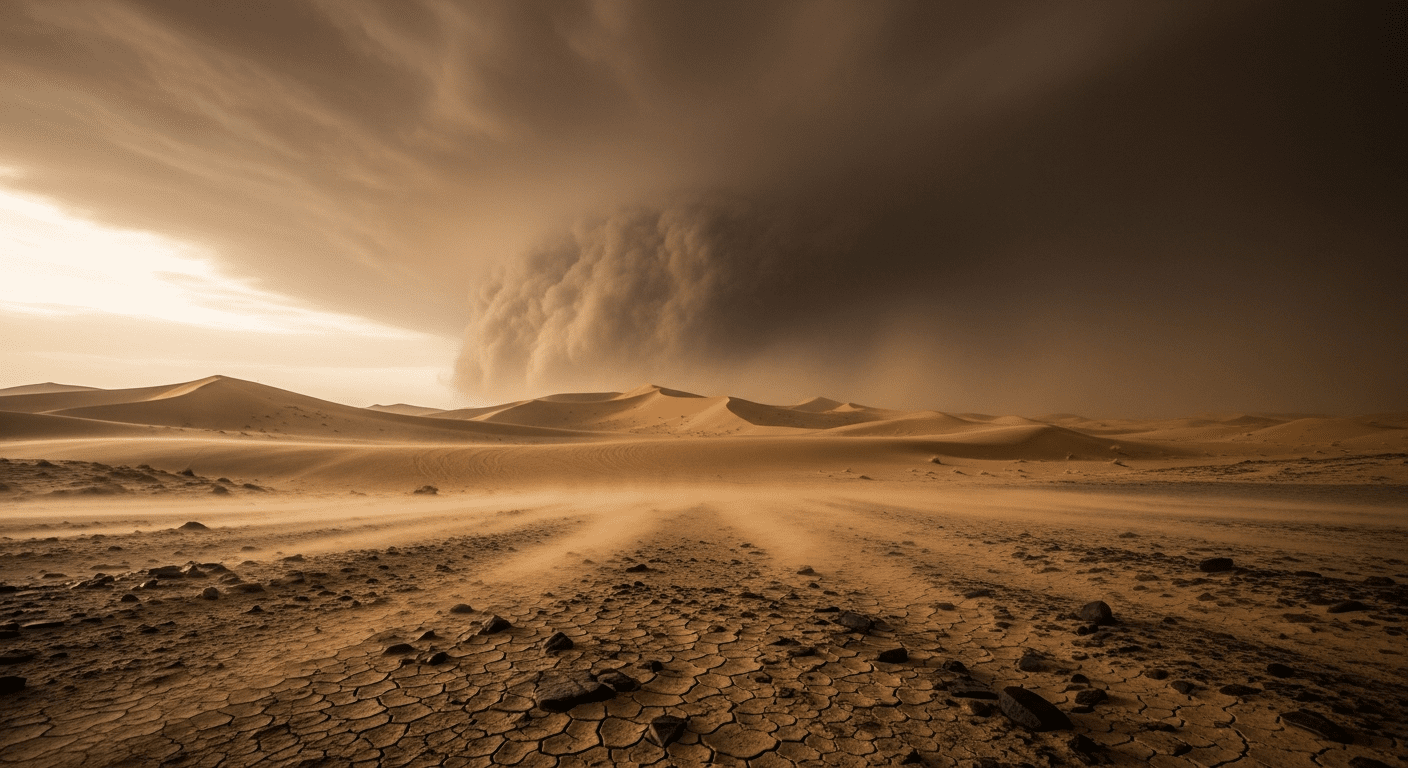
Facing a Sandstorm: Being blinded by swirling sand carries a very relatable anxiety. This variation usually connects to feeling overwhelmed or out of control in your waking hours. You might be dealing with a sudden, chaotic family conflict or a heavy workload that obscures your vision of the future. The stinging sand represents the small, irritating stresses that are currently compounding into a massive problem.
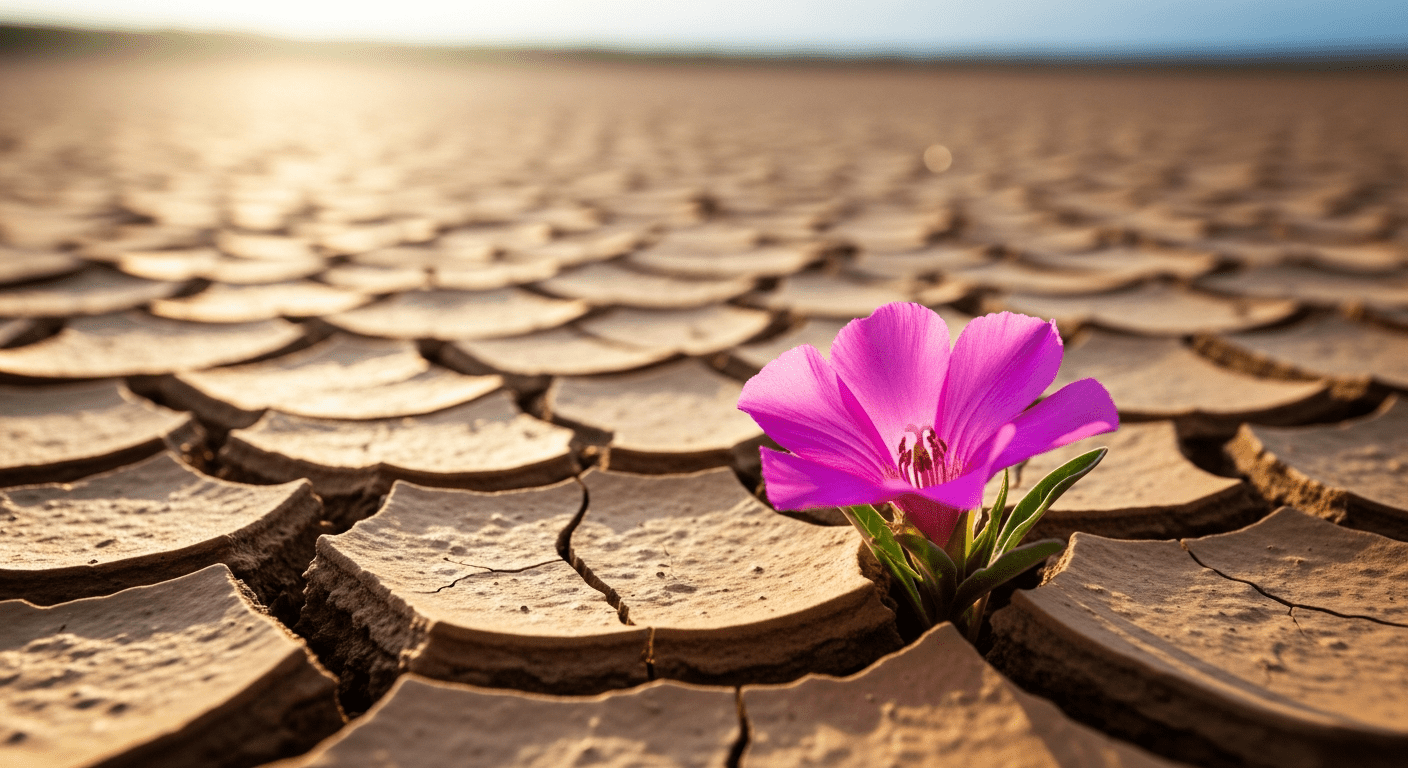
A Desert Blooming with Flowers: Sometimes the barren earth suddenly erupts in a beautiful superbloom. Symbolically, this represents unexpected joy, healing, or creativity springing up after a long period of feeling numb. It is a wonderful sign of renewal. Seeing flowers in the sand often means you are finally coming out of a difficult emotional drought.
Searching for Water: Tapping into a feeling of desperation is common in these dreams. Searching endlessly for a drink is the classic symbol of running on empty. This perfectly mirrors waking-life burnout where you are desperately seeking physical or emotional nourishment. (If this theme resonates, you might also find insight in our guide to Dreaming of Water: What Floods, Waves, and Deep Oceans Might Mean).
The Nighttime Desert: The visceral shift to freezing cold changes everything. A dark, freezing wasteland often points to feelings of isolation that only hit you at night. When you are alone with your thoughts and stripped of daytime busyness, loneliness can feel as sharp as a sudden drop in temperature. (This feeling of vast, echoing isolation is also common if you find yourself Dreaming of an Empty City: Symbolism and Meaning).
Connecting the Dream's Stillness to Your Everyday Life
You might ask yourself if you are currently running on empty. It is incredibly easy to give all your water away to your boss, your kids, or your partner. Doing so inevitably leaves you completely parched and exhausted. This dream is a vivid reminder to check your own reserves before you try to sustain anyone else.
Boundaries are another major theme here. The vast emptiness of the desert might literally be your subconscious begging for space. Your mind could be nudging you to say "no" more often to protect your energy. We often fill our calendars because we are afraid of letting people down. The dream is showing you what happens when you give away every inch of your personal territory.
Try to view the dream's stillness as an invitation rather than a punishment. The quiet might feel unsettling at first. However, it might be a clear signal to carve out actual, literal quiet time in your waking life. Reconnecting with yourself often requires stepping away from the noise and sitting comfortably in the silence.
Reflections to Carry Through Your Day
It can help to sit with a few questions as you go about your morning. You do not need to have the answers right away. Just let these thoughts simmer in the back of your mind.
- Where in your waking life are you currently running out of water or giving more energy than you take in?
- What felt heavier in the dream: the physical heat of the sun, or the emotional weight of being completely alone?
- If the emptiness of the desert was actually a blank canvas, what is the first thing you would want to build or plant there?
Embracing the Quiet After You Wake
A desert strips away the unnecessary to show us what is real. That reality might be a hidden anxiety, a desperate need for boundaries, or a deep reservoir of resilience you forgot you had. The emptiness is not there to scare you. It is there to give you a clean slate.
Feeling emotionally exposed in a dream can be jarring. Rest assured that it is actually a sign of a healthy mind trying to process, heal, and find clarity. You are doing the hard work of sorting through your feelings, even while you sleep. The next time you close your eyes, you might just find an oasis waiting for you.
If you would like a personalized symbolic interpretation, you can submit your dream here for a closer look. You can also explore more dream meanings on our blog to keep mapping out your inner world.

Written by Claire Sterling
Contributing Writer · Sleep Science & Cognitive Research
Claire Sterling explores how emotional stress and nocturnal cognition shape dreams, synthesizing peer-reviewed sleep research into warm, everyday reflections.
At DreamAtlas, interpretations are symbolic reflections grounded in universal human themes and peer-reviewed research, not clinical or medical advice.
Want to understand our approach? Read about our editorial standards →
Categories
Popular Symbols
Themes
Recent Posts
Dreaming of Failing a Simple Task Repeatedly
October 20, 2026What It Means When You Dream About Being Judged by a Group
October 15, 2026Dreaming of Snails – Patience, Delay, and Quiet Persistence
October 13, 2026What It Means When You Dream About Wolves Howling in the Distance
October 08, 2026Dreaming of Butterflies Landing on You
October 06, 2026About DreamAtlas
Your guide to exploring the symbolic meaning of your dreams. We offer thoughtful, reflective interpretations grounded in universal human themes.
Learn More
Comments