There are certain stories our dreaming minds love to tell, and the one about being stuck is among the oldest. The feeling is horribly specific: you need to run, with every fiber of your being, but your feet feel like they’re wading through cement. It’s a primal, frustrating fear, one that can leave your heart pounding long after you’ve woken up. This dream feels like a warning, but it’s also a conversation between your body and your mind, revealing both a simple biological reflex and a profound personal metaphor.
These interpretations are meant to spark reflection, not to serve as medical or psychological advice. They are possibilities to hold up to your own experience.
Quick takeaways:
- This dream is often a direct result of "REM atonia," your body's natural paralysis during sleep that keeps you from physically acting out what you're dreaming.
- Metaphorically, being unable to run often points to a real-life situation where you feel stuck, helpless, or unable to make meaningful progress.
- Ancient folklore didn't interpret this as a dream, but as a malevolent spirit (a "night-mare") literally holding a person down.
- The specific reason you can't run offers clues. Are you stuck in mud, suggesting external obstacles, or are your own legs failing you, pointing to internal doubts?
More Than a Feeling: What It Means to Be Stuck in Place
The most immediate interpretation of this dream is symbolic. Your mind is taking the abstract feeling of being stuck in your life and making it physically real. Think of a situation where you feel powerless: you know you need to speak up in a meeting, but the words feel caught in your throat. You know a relationship has run its course, but you feel rooted to the spot, unable to take the first step toward leaving. The dream gives that emotional paralysis a body.
This isn't always about escaping a threat. Sometimes, you're running toward something you desperately want, like a goal or an opportunity, but it never gets any closer. This points to a different kind of frustration, the feeling of putting in immense effort without seeing results. In a piece for Psychology Today, Seth J. Gillihan notes that feeling "trapped or unable to move" is a common nightmare theme, often connected to a sense of helplessness in our waking lives. The dream isn't just about the chase; it's about the gap between your intention and your ability to act.
The Safety Switch That Holds You Hostage
The terror of this dream isn't just a metaphor. It has a direct biological cause. During the REM (Rapid Eye Movement) stage of sleep, when most vivid dreaming occurs, your brain sends a signal to temporarily paralyze your voluntary muscles. This state is called REM atonia, and it's a brilliant safety feature. It’s what keeps you from leaping out of bed to literally fight the monster or run from the shadowy figure in your dream. You are, for all practical purposes, locked in place to keep you safe.
The problem arises when a part of your brain becomes just conscious enough to notice this paralysis. Your dreaming mind is screaming "RUN!" but your body, correctly, isn't responding. The result is that specific, infuriating feeling of your legs being made of lead or stuck in thick mud. The Sleep Foundation explains this as a brief mix-up between the sleeping and waking states. The very system designed to protect you is the exact mechanism that produces this profound sense of vulnerability and danger inside the dream. It’s a perfect, if terrifying, illusion.
The Ancient Ghost in the Machine
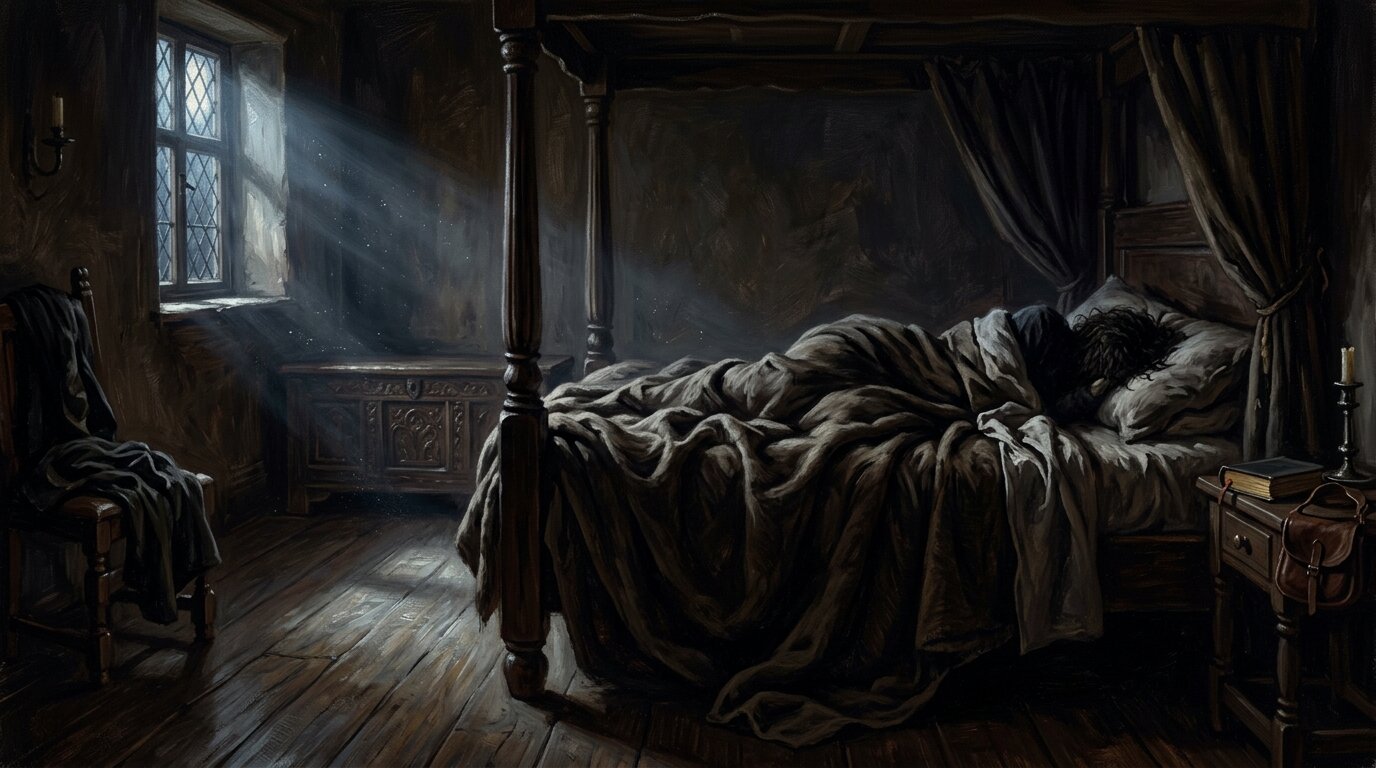
Long before we understood the neuroscience of sleep, people had another explanation for this horrifying sensation. The word "nightmare" itself tells the story. It didn't originally mean a bad dream. It referred to a malevolent spirit, the "mare" (from the Old English mære), a creature from folklore that would sit on a sleeper's chest, causing paralysis and terror. For centuries, this was the most logical explanation for waking up unable to move, with a heavy pressure on your chest and a sense of a sinister presence.
This folklore is a direct, intuitive story created to make sense of the physical pressure and paralysis of REM atonia. While our modern, scientific explanation demystifies the experience, there's a debate about what's lost. The clinical description is accurate, but the ancient story of the mare might do a better job of capturing the sheer, personal terror of the moment. It acknowledges the feeling that this isn't just a misfire in the brain, but something happening to you.
Slow Motion, Sticky Floors, and Heavy Limbs
The details of why you can't run can shift the dream's meaning. The texture of your powerlessness is a clue. Consider the difference between these common variations:
- Heavy or unresponsive limbs: If your own legs feel like they won't obey your commands, the dream may point toward internal obstacles. This could be a lack of confidence, self-doubt, or a fear of taking the next step.
- Running in slow motion: This often reflects a feeling of frustration in your waking life. You're trying, you're putting in the work, but you feel like you're not getting anywhere fast enough. It’s the dream equivalent of spinning your wheels.
- An environment that works against you: Are you trying to run through waist-deep water, thick mud, or a powerful headwind? This can symbolize external forces you feel are holding you back: a difficult job, a challenging relationship, or societal pressures.
- The endless hallway: In this version, you are running at full speed, but the door at the end of the hall never gets any closer. This can be a particularly maddening dream about chasing a goal that feels perpetually out of reach, no matter how hard you work.
It’s easy to get lost creating a detailed dictionary for each variation. Perhaps the specific obstacle is less important than the core emotion they all share: the feeling of powerless effort. There’s no settled answer here, but both the feeling and the details are worth considering.

What Your Feet Are Trying to Tell You Today
If this dream has surfaced recently, it might be an invitation to do a "power audit" on your waking life. Your subconscious may be sending up a compassionate alarm bell, asking a simple question: "Where are you feeling a critical lack of agency right now?" The dream is a spotlight, illuminating the friction between what you want to do and what you feel you can do.
Think about the one thing you would do tomorrow if you knew you couldn't fail. Is there a conversation you've been avoiding? A project you've been procrastinating on for weeks? A decision that feels too big to make? That's often the source of the resistance your dreaming mind is exploring. The trouble is, the dream is brilliant at pointing out the problem, but it rarely offers a solution. The frustration can linger after you wake up, a potent reminder that knowing you're stuck and knowing how to get unstuck are two very different things.
Questions for When You're Stuck
- In the dream, what were you running from, or what were you running toward? What does that target represent in your life right now?
- Think about the feeling in your legs as you tried to run. Does that sensation feel more like an external force holding you back, or an internal lack of strength?
- Where in your waking life do you feel like you're "running in place," putting in a lot of effort but not making progress?
- If you could give your dream-self one piece of advice or one tool to help them, what would it be?
- Is there a difficult situation you're avoiding? Is it possible this dream is your mind's way of "rehearsing" the feeling of facing it?
Your Body's Wisdom, Your Mind's Pace
The dream of being unable to run is not a glitch. It’s a conversation between the ancient, protective wiring of your body and the modern complexities of your mind. The feeling of paralysis is a biological reality, a harmless side effect of how sleep works. But the story your mind builds around that feeling, the narrative of the chase and the struggle, is a powerful clue to where your attention is needed most.
The dream isn't a sign that you're stuck forever. It's a spotlight on where you are ready to start moving again.
We’re always exploring the language of dreams. If this dream felt familiar, consider sharing the details of your experience with us at /submit-dream. You might also find personal connections in our articles on dreaming of being trapped in an elevator or the symbolism of dreams about endless hallways.

Written by Claire Sterling
Contributing Writer · Sleep Science & Cognitive Research
Claire Sterling explores how emotional stress and nocturnal cognition shape dreams, synthesizing peer-reviewed sleep research into warm, everyday reflections.
At DreamAtlas, interpretations are symbolic reflections grounded in universal human themes and peer-reviewed research, not clinical or medical advice.
Want to understand our approach? Read about our editorial standards →
Categories
Popular Symbols
Themes
Recent Posts
What It Means When You Dream About Wolves Howling in the Distance
October 08, 2026Dreaming of Butterflies Landing on You
October 06, 2026Why You Dream About Bears in Your Home
October 01, 2026Dreaming of Dolphins – Intelligence, Connection, and Emotional Depth
September 29, 2026What It Means When You Dream About Swarms of Bees
September 24, 2026About DreamAtlas
Your guide to exploring the symbolic meaning of your dreams. We offer thoughtful, reflective interpretations grounded in universal human themes.
Learn More
Comments