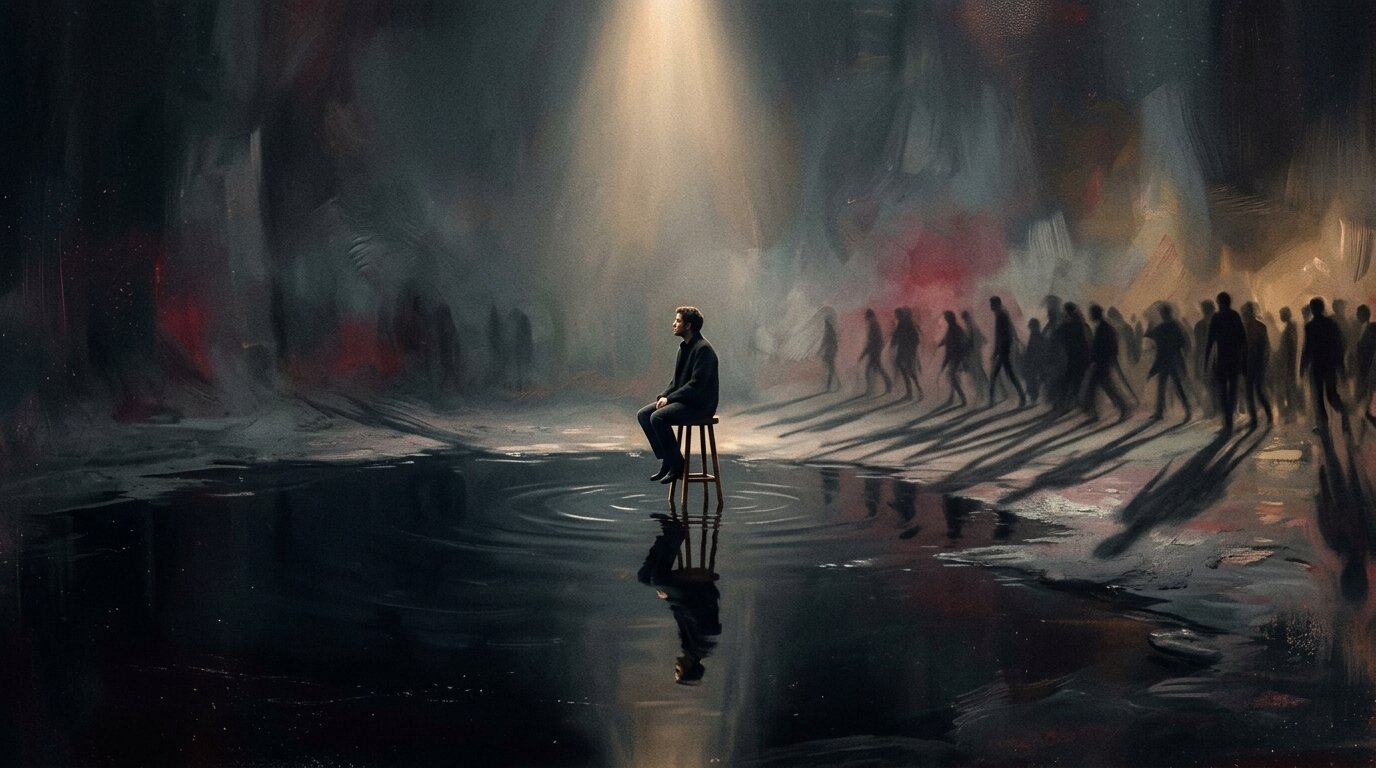
You’re standing at a podium, but there’s no speech in your hands. The light is dim, catching only the dust motes and a circle of faces around you. They are familiar, perhaps, but their expressions are closed. As one, they watch you, whispering to each other without making a sound, their disapproval a silent, unified hum in the air. The feeling is unmistakable: you have done something wrong, and you are being judged.
Waking from a dream like this leaves a residue, a heavy feeling in your chest and the lingering question, “What did I do?” These detailed scenarios of social trial aren't prophecies of your imminent exile from the group chat. Instead, think of them as your mind’s own way of processing what it means to belong. These interpretations are here to spark reflection, not to serve as psychological advice.
Quick takeaways:
- Your dreaming mind is a social simulator, running rehearsals of group dynamics to help you feel prepared for waking life.
- Dreams of harsh judgment often reflect your own internal critic projected onto a crowd, not what others actually think of you.
- The feeling of shame or exposure under a group’s gaze can be a sign that your REM sleep is working to process and file away recent social anxieties.
- Whether the group is silent strangers or disapproving loved ones can point to whether your stress is about performance or a deeper fear of personal rejection.
The Internal Tribunal: Why Your Brain Simulates Social Scrutiny
If you dream of being judged by a group, the first thing to know is that it’s rarely about the group. It is almost always about you. Your brain has created a courtroom drama where you are the star witness, but you are also the stern judge and the whispering jury. This dream is a projection, an externalization of your own inner critic, giving voice and form to anxieties about your own vulnerability and your place in the social world. You might dream you are standing in the middle of a brightly lit office while colleagues silently take notes, their glances communicating a shared, secret verdict. The feeling is of an external attack, but the source of the judgment is internal.
This isn't just speculation. Researchers have explored this very human tendency to work through our social lives while we sleep. A 2019 study by Jarno Tuominen, Tuula Stenberg, Antti Revonsuo, and Katja Valli confirmed what they call a "Sociality Bias" in dreaming, finding that our dreams contain significantly more social interactions than our waking lives. This suggests your mind isn't just passively replaying events, it’s actively simulating social scenarios to prepare you for them. The dream tribunal isn’t a memory, it’s a practice run.
The Burning Spotlight: Processing Shame and the Fear of Exposure
The emotional signature of this dream is often a hot, consuming shame. It’s that stomach-dropping moment when you realize you’ve shown up to a formal event in your pajamas, and every single person has turned to stare. The feeling of being exposed, flawed, and rejected is the entire point. While it feels awful in the moment, this intense emotion is a key part of how your brain processes and softens the power of social anxiety. Your dreaming mind is turning up the dial on humiliation in a safe environment to help you become less reactive to it in the real world.
Healthy REM sleep is crucial for this emotional recalibration. Work by Rick Wassing, Frans Schalkwijk, Oti Lakbila-Kamal, et al. in 2019 showed that effective sleep helps to downregulate our brain's reactivity to distressing and shameful memories. In a way, the dream is a controlled fire. It burns through the emotional charge of recent social fears, helping to neutralize them so they don’t follow you into the next day with the same intensity. The discomfort is not a bug, it’s a feature.
Echoes of the Tribe: The Primitive Fear of Excommunication
For most of human history, social rejection was not just embarrassing, it was a death sentence. Being cast out from the tribe meant losing access to food, shelter, and protection. Our nervous systems evolved during a time when group approval was directly linked to survival. This ancient programming doesn't just disappear because we now live in cities and order takeout. When you dream of a disapproving crowd, you are tapping into a deep, primitive fear of excommunication. It feels like an existential crisis because, for our ancestors, it was one.
This theme shows up in myths and stories from across cultures, with heroes standing before a council of elders or a tribunal of gods to justify their worth. Long before modern psychology, we understood the power of the group. A foundational 1995 paper by Roy F. Baumeister and Mark R. Leary established the "need to belong" as a fundamental human motivation, arguing that the prospect of rejection triggers powerful alarm systems. Your dream of being judged is your own nervous system running a very old and very serious emergency drill.

From Silent Panels to Murmuring Crowds: Decoding Dream Scenarios
The specific flavor of your dream tribunal can offer clues about the nature of your anxiety. A silent, faceless panel of authority figures who seem to be evaluating you against an unknown standard often points to professional anxieties or imposter syndrome. In contrast, a crowd of disappointed friends or family members can reflect a fear of letting people down or a feeling of failing in your personal relationships. You might even find yourself in a dream where you are being watched by silent observers, their stillness more unnerving than any accusation.
Interestingly, a silent crowd can sometimes feel more menacing than a shouting one. A loud, angry mob is clearly defined in its hostility, but a quiet group leaves a vacuum that your own worst fears rush in to fill. What are they thinking? What do they know? This is one of those areas where there’s no settled answer. Some dreamers report the silence as the most terrifying part, while for others, the noise is what stays with them. As research from Antonio Zadra, Sophie Desjardins, and Eric Marcotte on recurrent dreams shows, these threat simulations often feature social threats that the dreamer struggles to cope with, highlighting our attempts to work through these difficult dynamics.
Waking Rehearsals: What Your Mind Is Trying to Process Today
These dreams often appear when you're facing a real-world situation that involves social evaluation. Are you about to start a new job, give a presentation, join a new community, or have a difficult conversation? Your mind may be using the dream state to rehearse the feelings associated with being under scrutiny. The dream isn't a warning that you will fail, but rather a tool your brain is using to build up your emotional resilience for the actual event. By experiencing the worst-case scenario in a dream, you are better prepared to handle the reality with more calm.
This is connected to what sleep researchers Ross Levin and Tore Nielsen call "affect load." When our days are filled with high emotional pressure, especially from social stress, it can trigger intense and often troubling dreams at night. Your brain is not trying to torment you. It's working overtime to process a backlog of feeling, to make sense of the social pressures you are currently managing. The dream is a reflection of the work your mind is already doing.
Questions to Help You Decode Your Dream Tribunal
Thinking through the dream doesn't mean finding a single "right" answer. It is about staying with the questions it brings up. Here are a few to get you started:
- Whose face or voice in the judging group felt most familiar, and what do they represent to you?
- Were you trying to explain yourself in the dream, or did you accept their judgment in silence?
- What real-world situation in your life right now makes you feel like you are being put on trial?
- If the crowd's judgment was actually a projection of your own inner critic, what is it picking on?
- What would happen in the dream if you simply turned around and walked away from the judging crowd?
Stepping Down from the Witness Stand
Dreaming of group judgment is a profound and deeply human experience. It is not a sign that you are about to be cast out, but a sign that you care deeply about connection and belonging. Your dreaming mind is using its ancient toolkit to help you manage the complexities of modern social life, rehearsing scenarios and processing anxieties so you can face your day with a little more resilience. You don't need the crowd's approval, in your dreams or in your life, to be worthy of your place.
The court of your own mind does not have to hold you in contempt.
Had a dream that felt particularly vivid or strange? You can share it with us to help guide our future articles. You might also find insight in our explorations of dreaming of being followed by someone you know or what it means when you dream of losing your balance.

Written by Claire Sterling
Contributing Writer · Sleep Science & Cognitive Research
Claire Sterling explores how emotional stress and nocturnal cognition shape dreams, synthesizing peer-reviewed sleep research into warm, everyday reflections.
At DreamAtlas, interpretations are symbolic reflections grounded in universal human themes and peer-reviewed research, not clinical or medical advice.
Want to understand our approach? Read about our editorial standards →
Categories
Popular Symbols
Themes
Recent Posts
What It Means When You Dream About Being Judged by a Group
October 15, 2026Dreaming of Snails – Patience, Delay, and Quiet Persistence
October 13, 2026What It Means When You Dream About Wolves Howling in the Distance
October 08, 2026Dreaming of Butterflies Landing on You
October 06, 2026Why You Dream About Bears in Your Home
October 01, 2026About DreamAtlas
Your guide to exploring the symbolic meaning of your dreams. We offer thoughtful, reflective interpretations grounded in universal human themes.
Learn More
Comments