There’s a specific quietness to the feeling of being watched by something that isn't alive. It often begins with a sound you can’t quite place, a faint, high hum from an empty sky, like the ghost of an engine. You’re in your own backyard, maybe, or walking down a familiar street, and suddenly you feel the weight of an unseen lens, a gaze without a face, and you know you are being recorded.
This dream doesn't need monsters or chases to be unsettling; its power comes from this quiet violation of a private space. Exploring what this symbol might mean for you is a personal process, and these interpretations are simply a place to start your reflection, not a form of psychological advice.
Quick takeaways:
- If you feel constantly evaluated at work or in relationships, a drone dream may reflect your mind’s search for an unmonitored safe space.
- The persistent red light of a flying drone can symbolize an anxiety about exposure, a fear that private mistakes are being broadcast.
- Running or hiding from the drone often points to waking exhaustion from trying to escape expectations you feel powerless to change.
- When the observer has no human face, your mind may be wrestling with institutional or algorithmic pressures, not a conflict with a specific person.
The Eye in the Sky: Unseen Scrutiny and Lost Privacy
A drone in a dream is rarely just about the technology itself. Instead, it often symbolizes the feeling of being judged by an impersonal, detached observer. Think of standing in your own garden, a place that should feel safe, while a small black quadcopter hovers just overhead. Its lens silently follows your every move, and suddenly your sanctuary feels like a stage. You can’t reason with it, you can’t appeal to its humanity, because it doesn’t have any. It’s just an eye, watching.
This is where the dream's tension really clicks. While it feels like an external invasion, it can often stem from an internalized critic. The relentless observer might actually be your own punishing standards of perfection, tracking your every move and waiting for a mistake. Waking life stressors, especially those connected to performance and privacy, have a way of seeping into our sleep. A 2003 study in Consciousness and Cognition by Michael Schredl and Friedrich Hofmann demonstrated that our emotional preoccupations during the day are excellent predictors of what shows up in our dreams. The more you worry about being watched, the more likely your dreaming mind is to produce the perfect symbol for it.
Hyper-Vigilance in High Definition: The Emotional Weight of Being Tracked
The core emotional reality of a drone dream is a specific kind of helplessness. It’s born from asymmetric visibility: the drone sees everything about you, but you can’t see who, if anyone, is piloting it. This creates that gut-churning sensation of needing to hide, ducking under a porch roof knowing that even if you freeze, thermal sensors or wide-angle lenses might still register your presence. You are completely exposed, while the source of the scrutiny remains anonymous and untouchable.
This is where the dream can get complicated. On the surface, it creates an intense and understandable fear of persecution. But what does that panic sometimes mask? Is it possible the dream points to a deeper, conflicting longing to be truly seen and understood by someone who cares? There’s no settled answer here, as the feeling can pull in two directions at once. It might be a reflection of profound social anxiety, or it could be a sign that you feel invisible in your relationships, wishing someone would pay closer attention. Research published in Schizophrenia Research by Daniel Freeman and his colleagues found a clear link between disrupted sleep, hyper-vigilance, and an increase in paranoid thinking. When our waking mind is on high alert for threats, our dreaming mind often follows suit, creating scenarios of being tracked and monitored.
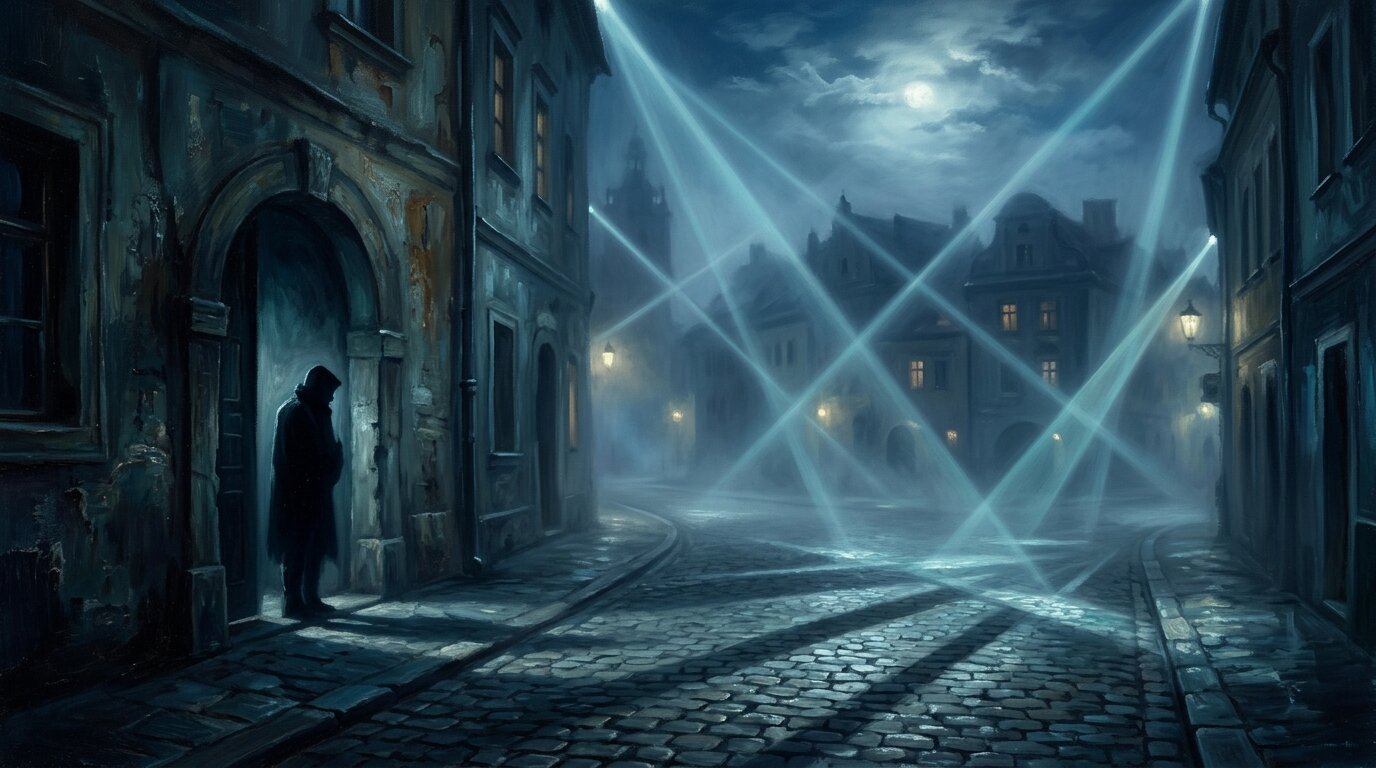
From the All-Seeing Eye to the Panopticon: Surveillance in Modern Myth
The idea of being watched from above is an ancient one. For millennia, it was the gaze of gods, spirits, or ancestors, a silent, all-knowing presence that judged human affairs. Today, that old fear has a new, mechanical form. The whirring plastic frame of a drone carrying a high-definition camera is the modern evolution of the mythical all-seeing eye or the raven carrying messages for a king. It’s the same archetype of cold, mechanical omniscience, just stripped of its spiritual robes.
This update puts a new spin on an old tension. Our culture frames surveillance as both a source of protective security and a tool of oppressive control. We install cameras for safety, but we fear having our data mined. This leaves the dreamer torn between a desire for safety and a craving for total freedom. The experience of being monitored during sleep studies provides a fascinating parallel. A 2021 study in PLOS ONE by Claudia Picard-Deland and colleagues found that over a third of participants in sleep labs had dreams that incorporated the laboratory setting, with many dreaming specifically of being observed by cameras and equipment. This suggests that when we know we are being watched, even for benign reasons, our minds can latch onto the imagery and explore its unsettling implications while we sleep.
Swarms, Lasers, and Silent Shadows: How Drone Dreams Shift
Not all drone dreams are the same, and the details matter. A single, silent drone hovering at dusk might point to a specific, nagging worry, a solitary source of pressure. But a buzzing swarm of tiny drones surrounding your house, blocking every door and window, suggests a feeling of being overwhelmed from all sides, as if there’s no escape from the relentless demands of your life. Other variations, like a drone with a searchlight or a laser, can amplify the sense of being targeted or exposed.
The dream’s narrative often involves trying to escape. You run, you hide, you try to find cover. This provides temporary relief, but what happens next is key. Does the drone always find you? According to research on threat simulation by Antonio Zadra and his team at the Université de Montréal, this pattern is quite common. Their work in Consciousness and Cognition showed that while the majority of recurring dreams contain threatening events where the dreamer takes evasive action, they rarely succeed in actually getting away for good. The dream isn’t about winning the chase; it’s about highlighting the feeling of being pursued by an anxiety that running from won't solve.
Reclaiming Your Unseen Self: Where Scrutiny Touches Your Waking Life
This dream often surfaces during life transitions where you feel your work, lifestyle, or personal choices are being evaluated under a microscope. It could be triggered by starting a new job with a micromanaging boss, managing the overexposure of social media where every post feels open to public critique, or even just feeling pressure from family to make certain life choices. The dream acts as a mirror, reflecting the external pressures you’re absorbing every day.
You might be quick to blame these outside forces, and you may be right to. Yet the dream also gently asks you to look at where you might be voluntarily surrendering your own privacy or blurring your personal boundaries. Research by Katja Valli and her colleagues on threat simulation theory showed that high levels of environmental stress and perceived vulnerability can trigger our internal threat-detection system to become hyperactive during sleep. Your dream of a drone isn’t a literal warning, but an emotional one, signaling that your sense of safety and autonomy is feeling threatened in your waking hours.

Questions to Help You Explore the Sky Above
- Where in your daily life do you feel like you are being evaluated or watched without your consent?
- Are you holding yourself to a standard of perfection that makes even private mistakes feel dangerous?
- What personal boundaries have felt blurred or compromised over recent weeks?
- If you could step out of view of the drone's lens, what quiet part of yourself would you want to protect?
- Is there a conversation or situation you are actively running from rather than addressing directly?
Stepping Out of the Red Light's Glare
The persistent hum of a dream drone can leave you feeling exposed and powerless, but its message isn't a forecast of doom. It's an invitation to look for the sources of perceived judgment in your life, both internal and external. This dream nudges you to build your own grounded, quiet spaces, to find the places where you don't have to perform or pretend. It’s a call to reclaim the simple, unobserved peace of being yourself, for yourself.
The sky in your dream doesn't have to be a source of anxiety. It can just be a sky.
Every dream is a private conversation waiting to be understood. If this one sparked something in you, you can share it with us. You might also find resonance in articles about dreaming of being trapped in a video call or what it means when you dream about being invisible.

Written by Claire Sterling
Contributing Writer · Sleep Science & Cognitive Research
Claire Sterling explores how emotional stress and nocturnal cognition shape dreams, synthesizing peer-reviewed sleep research into warm, everyday reflections.
At DreamAtlas, interpretations are symbolic reflections grounded in universal human themes and peer-reviewed research, not clinical or medical advice.
Want to understand our approach? Read about our editorial standards →
Categories
Popular Symbols
Themes
Recent Posts
What It Means When You Dream About Being Judged by a Group
October 15, 2026Dreaming of Snails – Patience, Delay, and Quiet Persistence
October 13, 2026What It Means When You Dream About Wolves Howling in the Distance
October 08, 2026Dreaming of Butterflies Landing on You
October 06, 2026Why You Dream About Bears in Your Home
October 01, 2026About DreamAtlas
Your guide to exploring the symbolic meaning of your dreams. We offer thoughtful, reflective interpretations grounded in universal human themes.
Learn More
Comments