That single, looping chime of a video call starting is a sound that shouldn’t exist in the deep quiet of a dream. Yet there it is, echoing in a digital void where you can’t find the mute button, your screen is frozen on a terrible angle, and you have the distinct, sinking feeling of being watched without being heard. If you’ve woken up from this specific modern nightmare, you’re not alone. It’s a dream that speaks volumes about the strange pressures of our connected lives.
These sorts of dreams are your mind’s way of working through complex feelings, not a literal prediction of your next team meeting going wrong. These interpretations are conversation starters meant to spark reflection, not to serve as any kind of psychological advice.
Quick takeaways:
- This dream is rarely about technology itself; it’s a vivid reflection of feeling constantly evaluated and unable to step away from expectations in your waking life.
- The panic of being unable to mute yourself or turn off your camera often points to a blurring of boundaries between your professional persona and your private self.
- Technical glitches in the dream, like a frozen screen, can symbolize a loss of agency in situations where you feel unheard or misunderstood.
- Ultimately, this dream can be a signal from your mind to reclaim offline rest and establish firmer boundaries.
The Grid of Unblinking Eyes: Why Tech Becomes Emotional Architecture
When you dream of being trapped in a video call, the anxiety isn't about software. It’s about the stage. The glowing grid of faces becomes a powerful symbol for social pressure, a virtual room where you feel intensely visible and emotionally exposed. You might dream of trying to click the “Leave Meeting” button, only to have the window reappear again and again, trapping you in a loop of silent, staring faces. The technology is just the landscape; the real story is the feeling of being stuck in a performance you didn’t agree to.
This lines up with what dream researchers have observed for a while. A 2003 study by Michael Schredl and Anja Hofmann found that while we rarely dream about the literal act of using a computer, our dreams are heavily populated with the social and emotional concerns from our day. Your brain seems to care less about the tool you were using and far more about the feeling of being seen, judged, or connected through it.
The Self-View Mirror: Impression Management and Emotional Exhaustion
Much of the unique panic of a video call dream comes from the self-view window. In waking life, we’re not used to watching ourselves interact with others in real time. This constant self-monitoring can be exhausting, and in a dream, that exhaustion is often amplified into raw terror. You might dream you’re totally unprepared for the meeting, frantically searching for a virtual background to hide a messy room that feels deeply personal and exposed.
You want to be seen and valued, but the pressure of being constantly visible can leave your nervous system longing to just disappear. This isn't just a feeling; it has measurable effects. Research from a team including Kristen M. Shockley and Allison S. Gabriel in 2021 demonstrated that keeping your camera on during virtual meetings significantly increases mental fatigue. The study points to "impression management", the continuous, tiring effort of managing how others see us, as a key driver of that exhaustion, which then follows us into our sleep.
The Panopticon of the Home Office: Modern Surveillance Culture
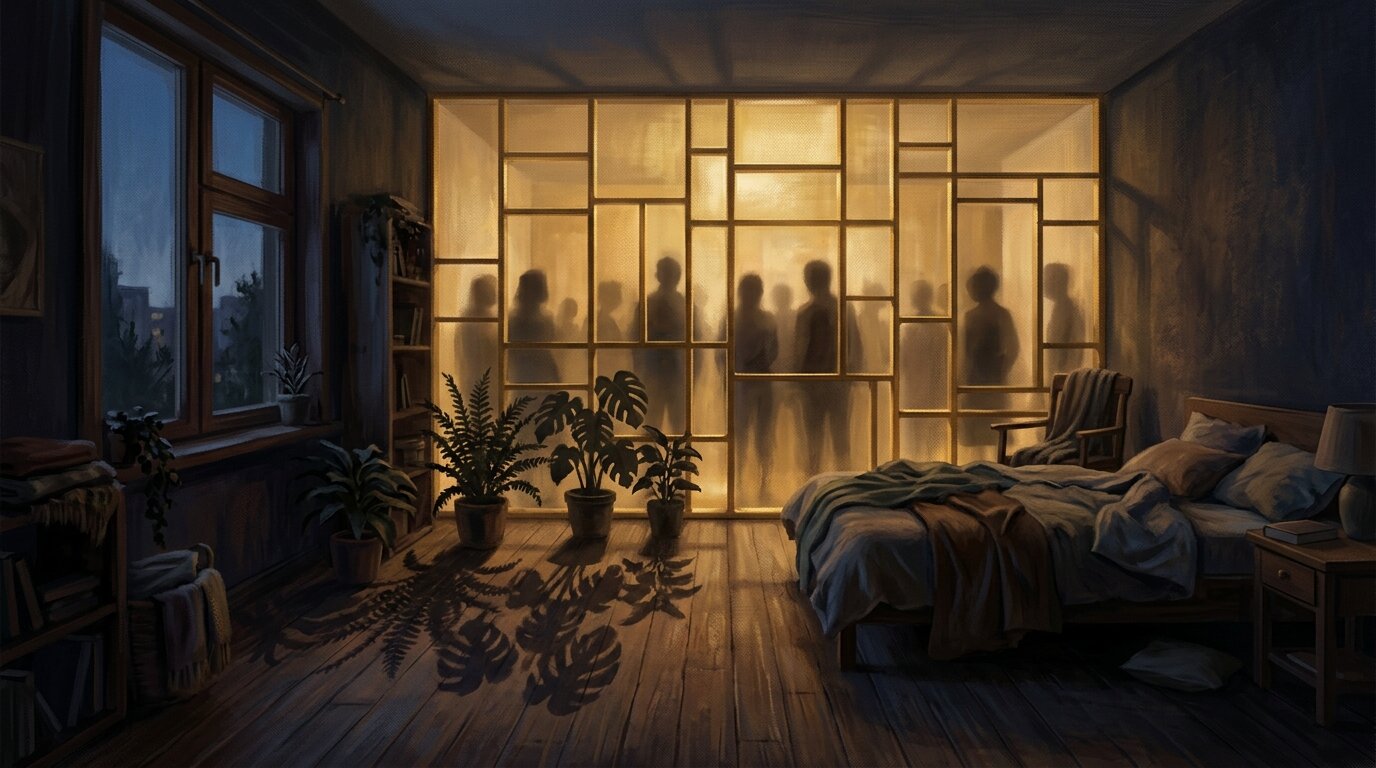
For generations, home was a sanctuary, the one place you could truly be offstage. The era of remote work has fundamentally changed that. Our living rooms have become boardrooms and our bedrooms have become backdrops, dissolving the boundary between private rest and public evaluation. A common version of this dream involves your bedroom wall transforming into a grid of observers, blurring the line between your safest space and a place of performance.
Digital tools promise freedom, but they can also tether us to an invisible, continuous audience from which escape feels impossible. The Stanford Virtual Human Interaction Lab identified a few reasons why video calls are so draining, including the unnatural intensity of staring at faces up close and the cognitive load of trying to interpret nonverbal cues through a screen. In a dream, these subtle drains on our energy become potent symbols of surveillance and confinement.
Frozen Frames and Muted Voices: Scenarios of Lost Agency
Not all video call dreams are the same. The specific technical glitch your dreaming mind chooses often maps directly to a waking fear of losing control over how you present yourself. If you dream of your screen freezing, it might reflect a feeling of being stuck or unable to move forward in a certain area of your life. A dream about accidentally sharing the wrong screen could point to a fear of revealing something private you’re not ready to talk about.
Perhaps the most common version is speaking urgently about something important, only to realize you’re muted and no one can hear you. This scenario almost always mirrors a waking situation where you feel your voice is being ignored or dismissed. Does the dream reflect a real threat your mind is preparing you for, or is it simply replaying the day's anxieties? Antti Revonsuo's Threat Simulation Theory suggests that dreams evolved to help us rehearse for challenging situations. But it's also possible that the dream is less a rehearsal and more an echo of a frustration you've already experienced. There's no settled answer here; the dream could be a warning, an echo, or a bit of both.
Reclaiming the Exit Button: What Your Mind Is Asking For
Ultimately, being trapped in a digital call during sleep can be your mind's urgent request to log off. It’s a powerful metaphor for feeling over-committed, perpetually available, and drained by the need to perform. The dream is a call to action to reset your boundaries, power down your performative habits, and find spaces where you can be fully unobserved. The feeling of entrapment is so potent because, in the dream state, our emotional centers are highly active while our logical problem-solving abilities are turned down. Research led by neuroscientist Pierre Maquet using brain imaging shows how this shift happens during REM sleep, which helps explain why a minor boundary issue from your day can feel like an inescapable, catastrophic trap in a dream.
Stepping away from constant availability can be scary. It can feel like you’re falling behind or letting people down. Yet your dream is suggesting that continuing to ignore the fatigue is the far greater risk. It’s an invitation to find the exit button in your waking life, not just on the screen.

Questions to Help You Unplug and Reflect
Sit with this dream for a moment and ask yourself a few quiet questions. There are no right answers, only honest ones.
- Where in your waking life do you feel like you are constantly on display or being evaluated?
- Are you holding back what you really want to say because of a fear of being misconstrued or judged?
- Which boundaries between your professional responsibilities and personal rest have become blurred lately?
- What would it feel like to step out of the spotlight for a few days without feeling guilty?
- When was the last time you allowed yourself to be fully unobserved and present in your own space?
Stepping Away from the Screen and Back into Yourself
This dream isn't a glitch in your system; it’s a feature of a mind trying to protect its own need for peace. It’s a reminder that even in a world that asks for constant connection, you always have the right to disconnect. The most important window to keep open is the one that looks into yourself.
Your dream is telling you it's okay to close the laptop and walk away.
Every dream is a private world with its own language. If you have a dream you’d like to understand better, feel free to share it with us. You might also find insight in our explorations of dreaming of a crowd staring at you or what it means when you dream about being invisible.

Written by Claire Sterling
Contributing Writer · Sleep Science & Cognitive Research
Claire Sterling explores how emotional stress and nocturnal cognition shape dreams, synthesizing peer-reviewed sleep research into warm, everyday reflections.
At DreamAtlas, interpretations are symbolic reflections grounded in universal human themes and peer-reviewed research, not clinical or medical advice.
Want to understand our approach? Read about our editorial standards →
Categories
Popular Symbols
Themes
Recent Posts
What It Means When You Dream About Being Judged by a Group
October 15, 2026Dreaming of Snails – Patience, Delay, and Quiet Persistence
October 13, 2026What It Means When You Dream About Wolves Howling in the Distance
October 08, 2026Dreaming of Butterflies Landing on You
October 06, 2026Why You Dream About Bears in Your Home
October 01, 2026About DreamAtlas
Your guide to exploring the symbolic meaning of your dreams. We offer thoughtful, reflective interpretations grounded in universal human themes.
Learn More
Comments