There’s a unique physics to our dreams, a private set of laws where the air can suddenly turn to honey. You try to run, to scream, to throw a punch, and a powerful, invisible resistance pushes back. This bizarre sensation of moving through water is one of the most common and compelling experiences we have in sleep, connecting our modern anxieties to the ancient, protective biology that governs how we dream.
Our exploration here is a way to sit with those feelings and get curious about their echoes in your waking life. Think of it as a friendly conversation meant to spark reflection, not as a substitute for professional mental health advice.
Quick takeaways:
- The slow-motion sensation isn’t just in your head; it’s a direct result of your brain sending real movement commands while your body is safely paralyzed during REM sleep.
- This dream often shows up when you feel stuck or held back in your waking life, whether by a difficult project, a relationship issue, or your own self-doubt.
- The feeling of helplessness is a paradox: it’s born from a sophisticated biological system designed to keep you completely safe while you sleep.
- Research on lucid dreamers confirms that physical tasks in a dream literally take longer to perform than mental ones, scientifically validating your experience of time slowing down.
Your Brain's Built-In Safety Brake
That classic dream of running down an endless hallway, your feet stuck in invisible concrete as you try to escape an unseen pursuer, feels intensely personal. Yet the slowness you experience isn't just a metaphor for your struggles. It has a real, measurable footprint in the sleeping brain. The feeling is the point, but the mechanism is fascinating.
This isn't just subjective. A 2014 study by Daniel Erlacher and his team found that when lucid dreamers were asked to perform physical tasks, it took them significantly longer than when they were awake, while purely mental tasks like counting took about the same amount of time. So, is the slowness just a literal side effect of how the brain processes things during sleep, or is it a perfectly crafted symbol for your waking frustrations? The answer seems to be both. The neurological reality of REM sleep creates the perfect canvas for your mind to paint a powerful, personal story about the things holding you back.
The Heavy Blanket of Helplessness
The most potent part of this dream is often the profound frustration that comes with it. You feel utterly powerless, ineffective, and trapped. It’s the distinct panic of trying to scream a warning to someone you love, but only a choked, silent whisper comes out. Your vocal cords feel paralyzed, and the sound gets swallowed by the dream’s heavy atmosphere. This feeling isn’t a comment on your character or your strength. It’s the direct sensory experience of a brilliant biological success.
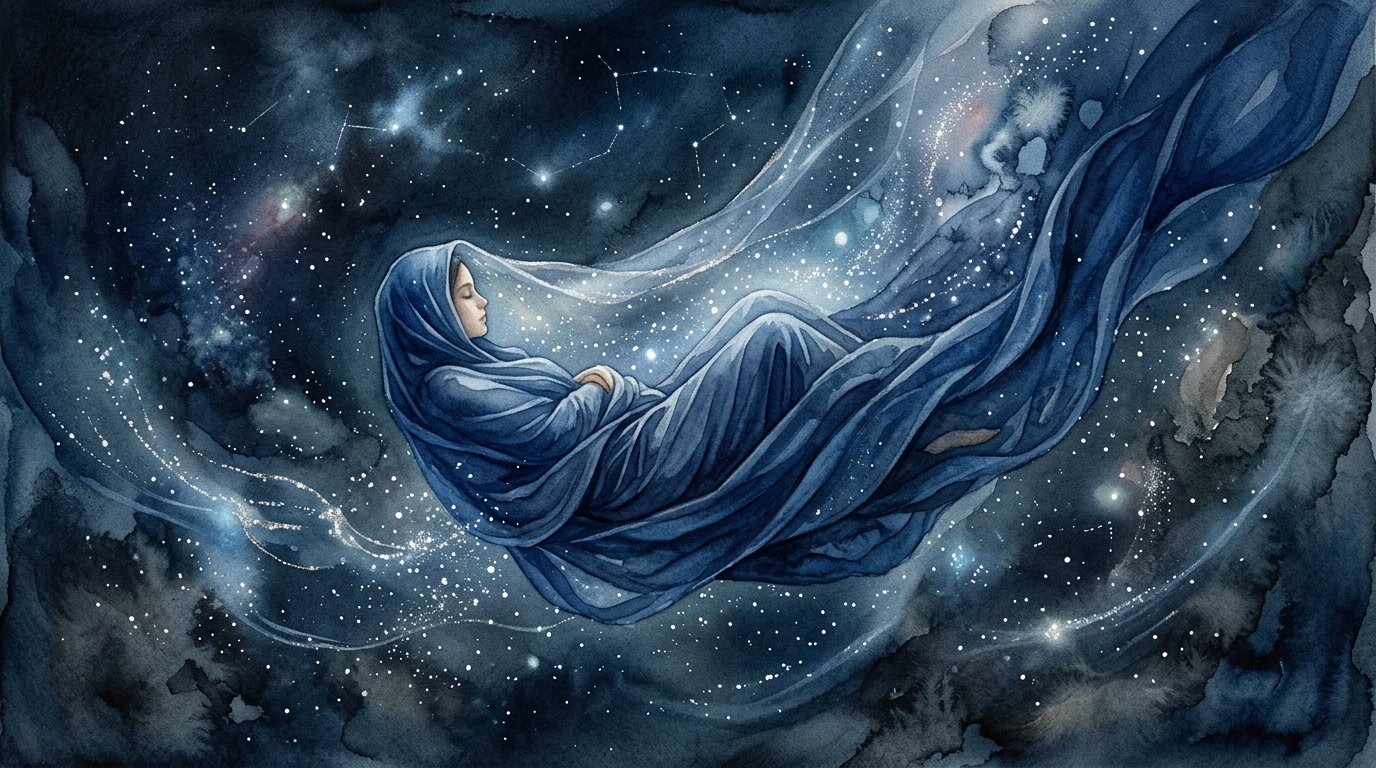
This sense of being pinned down has a clear biological source. In a 2015 article in Frontiers in Neurology, a team led by John H. Peever explains the specific brainstem circuits that trigger what’s called REM atonia. This is a temporary paralysis of your major muscle groups, and it’s what keeps you from physically acting out your dreams. The dream can feel terrifyingly real, stirring up a deep sense of vulnerability. Yet its source is a sophisticated protective mechanism. Herein lies the core paradox: a feeling of being in peril that is born from a system of absolute safety.
Echoes of Sisyphus: When We Dream of Struggle
The feeling of being stuck or facing an impossible task is a foundational human experience. It’s captured in myths and legends across cultures, from Sisyphus pushing his boulder for eternity to Tantalus forever reaching for fruit that pulls away and water that recedes. These ancient stories are more than just tales; they are waking-life versions of the same universal frustration your dreaming mind is processing through the language of slow motion.
These myths are perfect parallels to the feeling of running through dream-mud, of giving enormous effort for no reward. It raises a kind of chicken-and-egg question about our inner and outer worlds: do our ancient stories simply reflect a universal fear that gets expressed in our dreams, or do our shared, biologically-driven dreams of paralysis actually give birth to these kinds of cultural narratives? There’s no settled answer here. It shows just how deeply the theme of powerless struggle is woven into our shared human consciousness.
Fists of Feather, Voices of Mist
The specific action you are struggling to perform is a crucial clue. While the feeling of resistance is universal, the details of your dream are deeply personal. Trying to run often relates to your ambitions or a desire to escape a situation. Dreaming of being unable to run can point to external obstacles or internal fears that are slowing you down. Trying to scream suggests you feel your voice isn't being heard or your opinion isn't valued in a key area of your life.

Then there’s the classic dream of conflict. You’re in a heated argument and you go to land a decisive punch, but your arm moves with an agonizing slowness, as if pushing through thick honey. When it finally connects, it has all the impact of a feather. This leaves you feeling utterly powerless and ineffective. Does a slow-motion punch mean you are afraid of your own anger and are actively suppressing it, or does it mean you feel your anger is completely useless in a particular situation? The dream presents the raw feeling of powerlessness, but you have to look at your life’s context to understand its specific source.
Where Is the Friction in Your Life?
This dream often acts like a compassionate diagnostic tool. It points with surprising accuracy to the specific area of your life where you feel your effort isn't matching the outcome. It’s not about a past failure or a future fear, but about the friction you are experiencing right now. The feeling is immediate and present.
For example, maybe you've been working tirelessly for a promotion at work, putting in extra hours and taking on new responsibilities. A key manager, however, seems to be consistently overlooking your contributions, and you feel your career is stuck in first gear. The dream of running in place perfectly mirrors that feeling of giving 100% effort for what feels like 0% progress. The dream can feel like a harsh verdict, as if it's saying "you can't succeed." It’s more accurately interpreted as an invitation to investigate, asking "Why does this feel so hard right now?" It's the difference between a stop sign and a 'check engine' light.
Questions to Carry Into the Day
These dreams don’t ask to be solved, but they do invite curiosity. When you wake up from one, instead of shaking it off, try sitting with it for a moment. You might ask yourself:
- In your dream, what specific goal were you trying to achieve with your slow movement? Were you running toward something desirable or away from something threatening?
- Who or what else was present in the dream? Did their presence make the struggle harder or were you fighting to get to them?
- Think about your week. Where have you felt like you were "running through mud", putting in a huge amount of effort for very little visible progress?
- The dream combines a powerful, urgent desire to act with a physical inability to do so. Where in your life are your ambitions and your actions currently out of sync?
- If you were to stop fighting the slowness in the dream, what do you imagine would happen next? What might "surrendering" to the resistance look like in your current waking-life challenge?
Finding Your Stride
The dream of moving in slow motion is not a prophecy of failure. It is a compassionate signal from your own mind to gently investigate what’s causing resistance in your life. The feeling of being held back is an invitation to find a new path forward, not a verdict on your abilities or your worth. It's a sign that something needs to change, perhaps not your effort, but your direction.
The dream doesn't tell you that you are weak; it reminds you where you are pushing against a locked door.
Every dream is a private conversation. If you’d like to share yours and see it interpreted in a future post, you can submit your dream to us anonymously. If the theme of being stuck resonates, you may also find insight in our explorations of feeling extremely heavy in a dream or dreaming of a collapsing bridge.

Written by Claire Sterling
Contributing Writer · Sleep Science & Cognitive Research
Claire Sterling explores how emotional stress and nocturnal cognition shape dreams, synthesizing peer-reviewed sleep research into warm, everyday reflections.
At DreamAtlas, interpretations are symbolic reflections grounded in universal human themes and peer-reviewed research, not clinical or medical advice.
Want to understand our approach? Read about our editorial standards →
Categories
Popular Symbols
Themes
Recent Posts
What It Means When You Dream About Wolves Howling in the Distance
October 08, 2026Dreaming of Butterflies Landing on You
October 06, 2026Why You Dream About Bears in Your Home
October 01, 2026Dreaming of Dolphins – Intelligence, Connection, and Emotional Depth
September 29, 2026What It Means When You Dream About Swarms of Bees
September 24, 2026About DreamAtlas
Your guide to exploring the symbolic meaning of your dreams. We offer thoughtful, reflective interpretations grounded in universal human themes.
Learn More
Comments