There’s a strange and beautiful magic that happens in the dead of night. You’re standing on a stage, or maybe in a quiet room, and you’re holding a violin. You’ve never held one in your life, but in the dream, your hands know exactly what to do. The music that flows out is breathtaking, a complex and soulful melody that feels more real than your own heartbeat. Then you wake up, and the music is gone. The only thing left is the quiet hum of your refrigerator and the bittersweet echo of a skill you never had.
This experience is a common gift from the dreaming mind, a glimpse into a fluency we don't possess in our waking hours. These interpretations are meant to spark reflection, not serve as medical or psychological advice. They are simply a way to sit with that lingering melody and wonder what it was trying to say.
Quick takeaways:
- Dreaming of playing an instrument you can't is rarely about music—it's your mind exploring a new way to express a feeling or idea you don't have words for yet.
- The specific instrument is a clue: a loud trumpet might symbolize a need to be heard, while a complex piano piece could represent a desire for mastery and control in a chaotic situation.
- The feeling of playing (effortless joy, frustrating struggle, quiet focus) is the most important part of the dream's message, reflecting an emotion you either have or long for in your waking life.
- This dream often signals a readiness for creative problem-solving, suggesting your mind is rehearsing new approaches to a challenge, unburdened by self-doubt.
What Your Inner Orchestra Might Be Trying to Tell You
Let’s get one thing straight: this dream probably isn’t your subconscious nagging you to sign up for guitar lessons (though you certainly can). More often, the instrument is a metaphor for a hidden voice. It represents a part of you that’s ready to be expressed, a quality or feeling that hasn’t found its way into your daily life.
Imagine an accountant, someone whose days are defined by rules and precision, who dreams of playing a wild, improvisational jazz saxophone solo. The dream isn't telling him to quit his job and join a band. It’s pointing to a deep craving for more spontaneity, risk, and creative freedom in his highly structured world. The saxophone is just the symbol for that unexpressed, looser part of himself.
So, is the dream a call to action or just a symbol? This is one of those places where interpretations can split. It can absolutely be both. Sometimes the symbolic nudge is so powerful it inspires a new real-world hobby. But the core message is usually about the quality of the expression—the improvisation, the harmony, the sheer volume—not the activity itself.
The Music of Your Emotions
The most direct clue in these dreams is the sound itself. The emotional tone of the music you’re playing is a direct line to your current subconscious state. Your dreaming mind bypasses all the polite, analytical filters you use during the day and shows you exactly how you feel underneath it all.
Perhaps you dream you're playing a cello, and the music is so profoundly sad and beautiful that it brings a listening crowd to tears. In your waking life, you’ve been telling everyone, “I’m fine, really,” after a recent loss. The dream, however, reveals the deep, unexpressed grief you’re carrying. More than that, it reveals your desire for that grief to be seen and acknowledged by others.
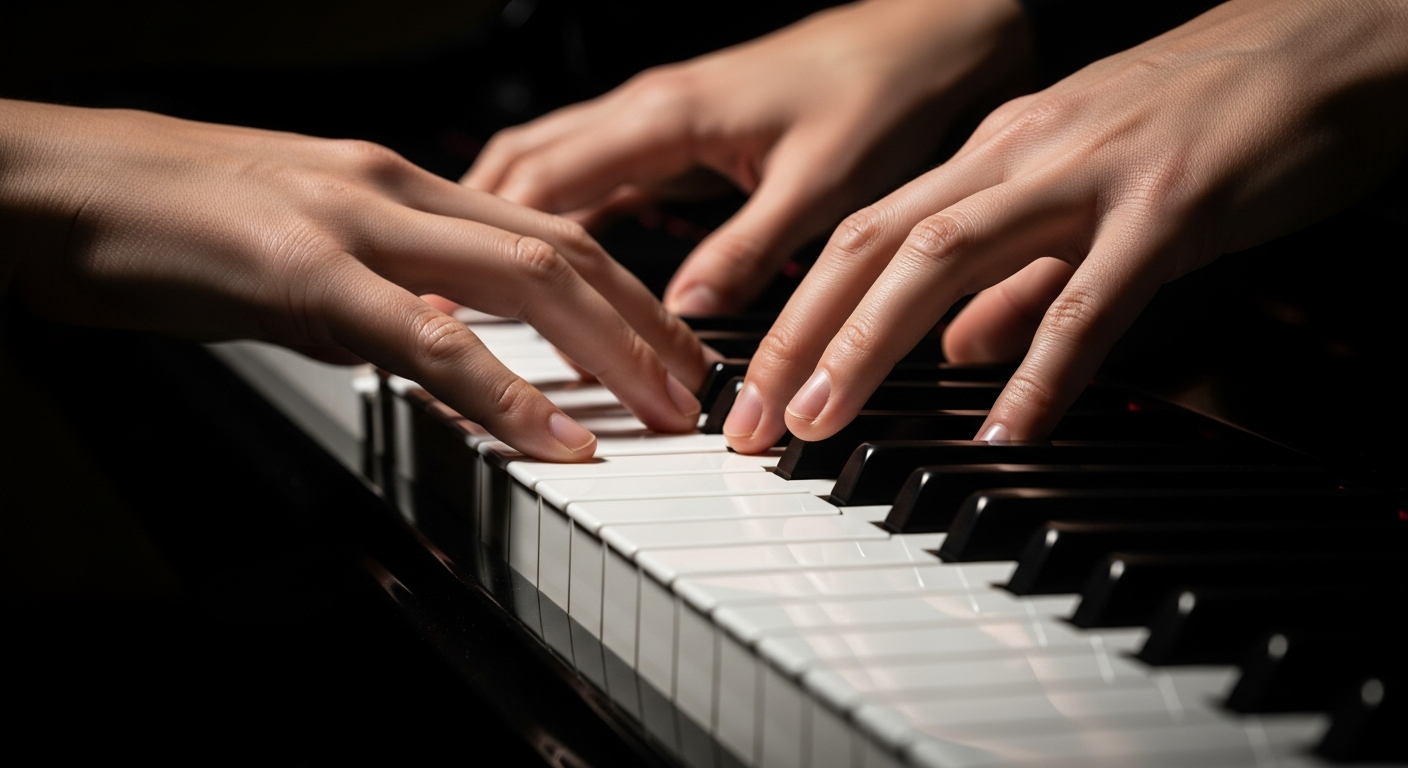
Sometimes the emotion can feel contradictory. You might be playing a joyful, upbeat tune on a piano but feel a deep sense of anxiety in the dream. This could symbolize a pressure to perform happiness for others, a disconnect between how you feel on the inside and the cheerful "music" you're putting out into the world.
From Ancient Flutes to Your Dreaming Mind
Musical instruments are some of our oldest tools for communication. For thousands of years, we've used them to connect with something deeper: the gods, the community, our own souls. Your dream might be tapping into this ancient, universal history, using an instrument as an archetype for connection.
Dreaming of playing a simple, hand-carved wooden flute by a river isn't just a random image. It taps into a primal picture of a shepherd or a shaman, someone connected to the natural world. This kind of dream might suggest a desire to connect with a more intuitive, spiritual, or grounded part of yourself, far from the noise and demands of modern life.
Does your dreaming mind really know about ancient archetypes, or did you just see a scene like that in a movie once? Honestly, it doesn't matter. The power of a symbol isn’t about its historical accuracy. What matters is what it evokes in you, whether that feeling comes from a history book or a film score.
When the Melody Changes: Common Dream Variations
The details in a dream can completely change its meaning. The context and condition of the instrument are just as important as the act of playing it, shifting the feeling from pure expression to pure frustration.
- A Broken Instrument: You’re on stage with a guitar, but one of the strings is broken. This can point to a feeling that you have a message to share, but you lack a key component to do so effectively. Maybe you don’t have the confidence, the right words, or the support of a specific person you need.
- Playing the Wrong Notes: You’re at a piano, but every note you play is jarring and dissonant. This often reflects a feeling of being out of sync with your environment or with yourself. It can show up when you feel like your actions and intentions aren't aligning, creating internal conflict.
- No One Is Listening: You play the most beautiful song you’ve ever heard, but the room is empty or the crowd is completely indifferent. This is a classic dream about feeling unseen or unheard, a fear that your contributions, feelings, or ideas are being ignored. This can feel similar to a dream about being invisible.
- A Strange or Made-Up Instrument: Sometimes the instrument is something you've never seen before. This is often a sign that your mind is trying to invent a new way of communicating or solving a problem, one for which no existing "tool" will suffice.
It’s easy to get lost trying to interpret every single detail. The best guide is your own feeling. Which part of the dream held the most emotional weight? The broken string was probably more significant than the color of your shirt.
Tuning In to Your Waking Life
More than anything, this dream is often a sign that your mind is in a highly creative state, working on a problem in the background. It’s using the metaphor of musical composition to find a new, elegant solution to something complex in your life.
Think of a software developer who has been stuck on a difficult coding problem for days. She dreams of flawlessly conducting a massive orchestra, bringing hundreds of different instruments and voices into perfect, soaring harmony. The dream is a form of non-verbal thinking. Her brain is letting her feel the shape of the solution before she can articulate it logically. Research indexed by the National Institutes of Health (NIH) has found that the brief, drifty state of falling asleep can be a "sweet spot" for creativity, suggesting our minds are actively rehearsing new ideas as we sleep.
This can feel both empowering and a little frustrating. If your dreaming mind has the answer, why doesn't it just tell you? Because dreams often communicate in feelings, not instructions. The dream offers the creative sensation of the solution, but it still requires your conscious, waking effort to translate that feeling into a practical, real-world action.
Questions to Ask Your Inner Composer
If this dream has stayed with you, it can help to sit with a few questions. Don’t search for the "right" answer, just notice what comes to mind.
- Who was listening to your music in the dream? Were you playing for yourself, for a specific person, or for a faceless crowd?
- What was the feeling of the instrument in your hands? Did it feel familiar and natural, or foreign and awkward?
- If the melody you played had a title, what would it be? (e.g., "The Argument I Need to Have," "A Secret Hope," "Letting Go.")
- Beyond music, where in your life are you craving this kind of effortless expression, harmony, or control?
Finding Your Rhythm
Ultimately, dreaming of a musical skill you don’t have is a gentle reminder that you have a unique "song" to share, even if you don't think of yourself as a creative person. It’s an invitation from a deeper part of you to find a way—any way—to give voice to the feelings that have been silent for too long.
You don’t have to become a musician to honor this dream. Your "instrument" could be finally having a difficult conversation, picking up a paintbrush for the first time in years, or simply allowing yourself to be more honest and authentic in your relationships. The dream is just a beautiful, encouraging glimpse of your own untapped potential, waiting for you to play.
Some dreams just want you to listen.
If this dream is still with you, share it with us. Or keep exploring the dreams we've written about.

Written by Julian Thorne
Contributing Writer · Mythic & Archetypal Symbolism
Julian Thorne explores the universal metaphors in human storytelling, drawing upon comparative mythology, literature, and archetypes.
At DreamAtlas, interpretations are symbolic reflections grounded in universal human themes and peer-reviewed research, not clinical or medical advice.
Want to understand our approach? Read about our editorial standards →
Categories
Popular Symbols
Themes
Recent Posts
What It Means When You Dream About Swarms of Bees
September 24, 2026Dreaming of Owls Watching You Silently
September 22, 2026Why You Dream About Turtles Moving Slowly Beside You
September 17, 2026Dreaming of Horses Running Wild
September 15, 2026What It Means When You Dream About Giant Insects
September 10, 2026About DreamAtlas
Your guide to exploring the symbolic meaning of your dreams. We offer thoughtful, reflective interpretations grounded in universal human themes.
Learn More
Comments