You're mid-sentence at a family dinner, or maybe just walking through your brightly-lit kitchen to get a glass of water, and then click. The world doesn't just go dark, it vanishes. There’s no warning, no flicker, just a sudden and total absence of light that leaves you frozen, your last thought hanging unfinished in the air.
Waking from a dream like this can leave you feeling disoriented long after your eyes adjust. It’s less about a fear of the dark and more about the shock of being so completely blindsided. These interpretations are designed to be a starting point for your own reflection, not a substitute for professional psychological advice.
Quick takeaways:
- A sudden blackout often points to an area of your life where your sense of control or direction has been abruptly cut off.
- The dream can be your mind’s fire drill, rehearsing how to handle sudden, unforeseen bad news or a dramatic shift in circumstances.
- When the lights go out mid-activity, it may be a signal of burnout, or a deep need to stop pushing forward on autopilot.
When the Lights Go Out: What Abrupt Loss of Vision Signals
A dream of sudden darkness often acts like a psychological circuit breaker. When your waking life is filled with too much noise, too much data, or too much pressure to perform, the dream plunges you into sensory silence. It’s an intentional stripping away of the visual world to force you to confront what’s left. This dream may be showing up because there's a blind spot in your life, an area you are refusing to look at, and your subconscious has decided to turn off everything else so you can finally notice it. It isn’t a punishment, but a recalibration, forcing your attention inward when your outward gaze has become fixed or avoidant.
The feeling isn't always one of peace, however. The suddenness can feel like an external threat, an ambush. But the source might be internal, a deep and unacknowledged desire to simply stop and escape the overwhelming pressure of what you’re expected to see and process every day. The ambush, in this reading, is one you’ve laid for yourself, a desperate act of self-preservation. Research on dream content by Katja Valli and her colleagues shows that our brains are remarkably good at running these kinds of threat simulations, which may help us test our emotional responses to high-hazard situations from the safety of sleep.
The Emotional Weight of Being Blindsided
The primary feeling that lingers after a blackout dream isn't usually a fear of monsters in the dark. It’s the acute, heart-pounding vulnerability of being caught completely off guard. One moment, you have your bearings; the next, you are adrift in an undefined space. The dream taps into a primal fear of the unknown, making the familiar suddenly alien. You might feel a claustrophobic dread as the space around you seems to shrink, every unheard sound amplified in the absolute quiet. Your own bedroom can suddenly feel like an unfamiliar cave, the distance to the door an impossible journey.
This intense anxiety over what might be hiding in the shadows often mirrors an unexpressed dread about the unpredictability of your waking life. In a study of recurring dreams, Antonio Zadra and his research team found that the majority of these dreams contained threats that put the dreamer in sudden danger, and the dreamer rarely managed to escape. This suggests the dream isn’t about winning or finding the light switch; it’s about sitting with the raw feeling of being powerless for a moment. This mirrors those waking moments when all you can do is wait for the test results, the call back, or the storm to pass, moments where control is an illusion.
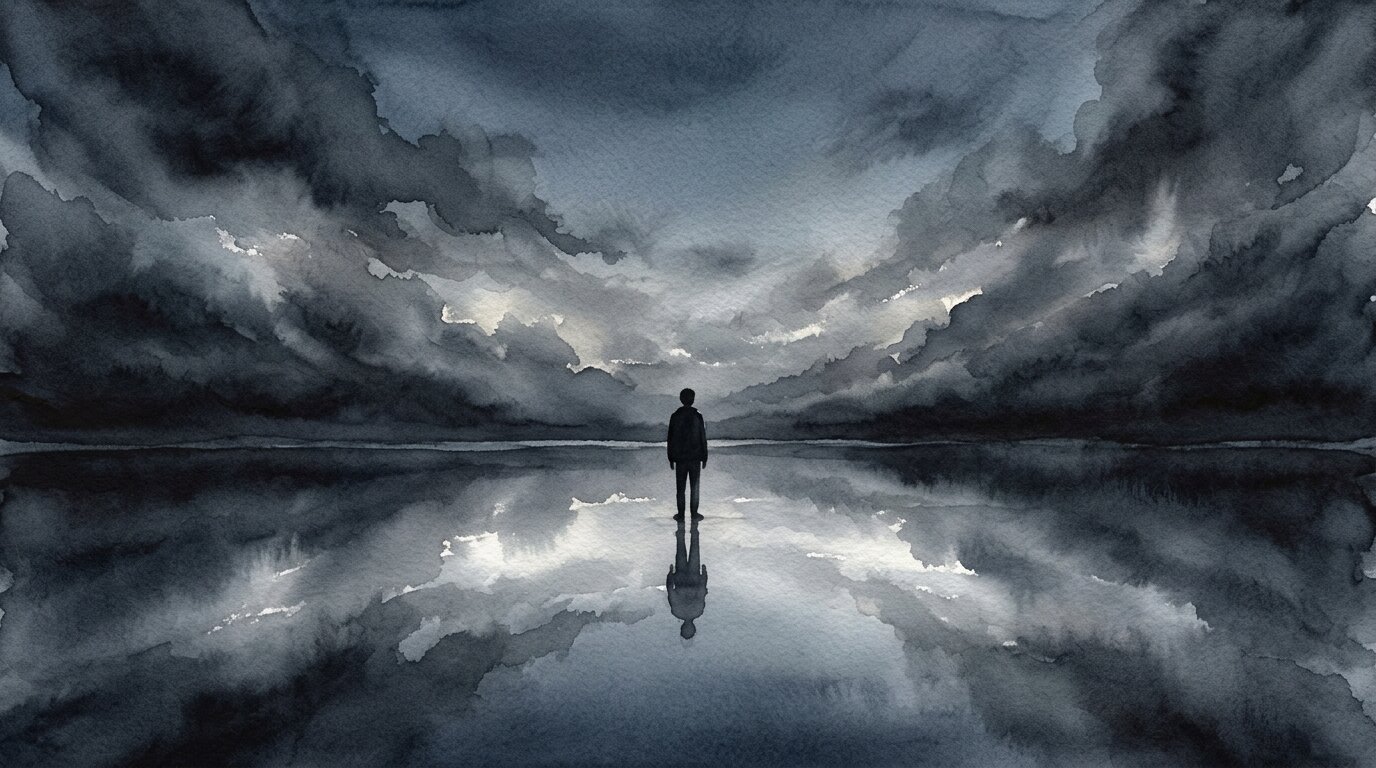
Shadows, Primordial Void, and the Unseen Path
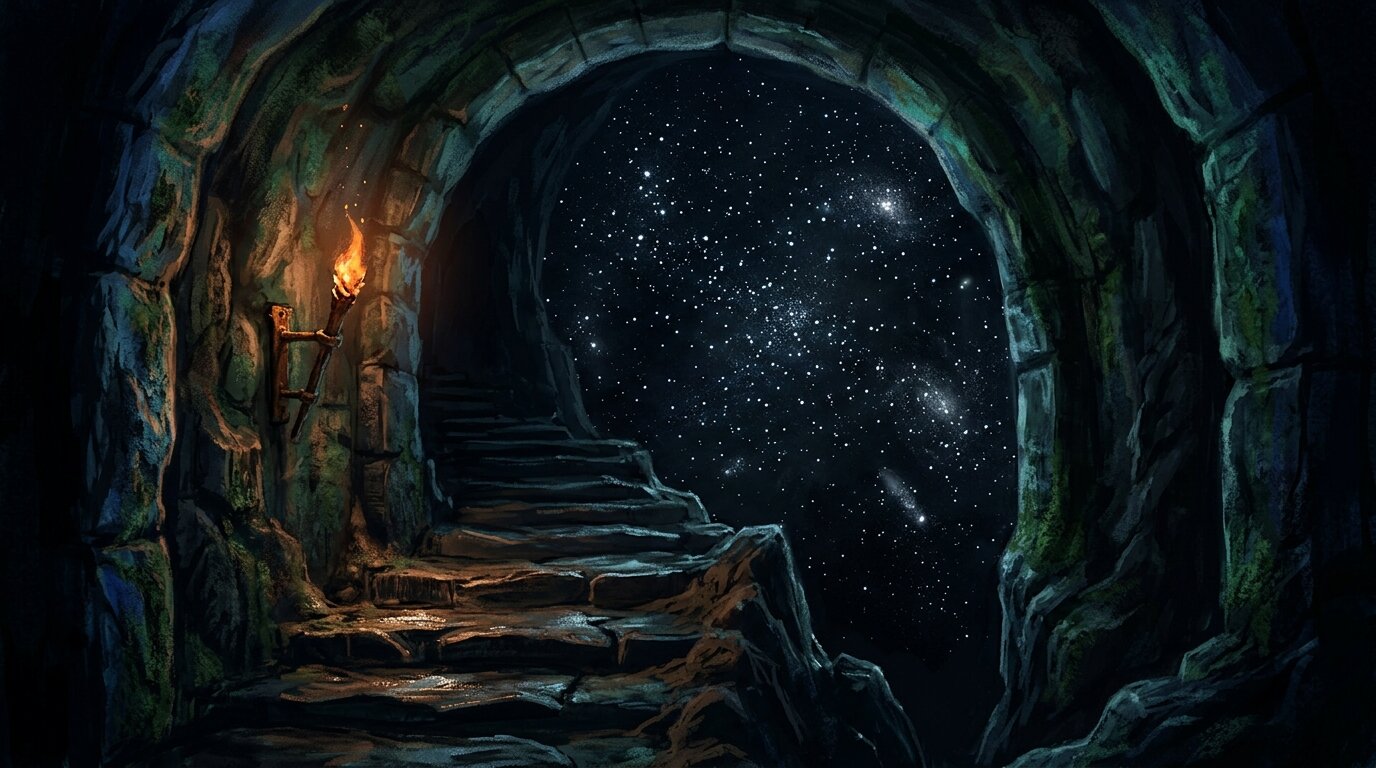
Across countless myths and stories, a hero’s journey frequently involves a descent into darkness. Think of a traveler in a labyrinth whose torch is abruptly blown out, forcing them to rely on instinct and touch rather than sight. In these tales, sudden darkness isn't just a problem to be solved; it’s a threshold. It marks the point where conscious intellect and brute force must give way to a deeper, more intuitive way of knowing. This is the part of the story where the hero learns to read the wind or feel the vibrations in the stone, relying on senses they previously ignored.
Here, interpretations really diverge. Is the darkness an enemy to be overcome, or a quiet space to be entered? Modern culture often frames a blackout as a dangerous loss of control, a system failure. Yet, many spiritual traditions see these dark moments as necessary transitional spaces, like a seed underground before it sprouts. There’s no single right answer, and the meaning often depends on what you bring to the dream yourself. Your personal relationship with darkness, whether you find it comforting or terrifying, is a huge part of the puzzle.
Power Outages, Fading Sun, and Heavy Eyelids: Decoding Variants
How the darkness arrives can shift the meaning. A sudden city-wide power outage, for example, points toward external disruptions beyond your control. It could reflect broken trust in a system you rely on, whether that’s at work, in a relationship, or in society at large. In contrast, flipping a light switch that simply doesn't work often reflects a personal feeling of powerlessness or a loss of your own agency. It's a particularly frustrating dream scenario, pointing to efforts in your waking life that aren't producing results, leaving you feeling ineffective.
A dream where the sun plummets below the horizon in seconds is different still, suggesting a natural cycle has been unnervingly accelerated. Then there’s the unique experience of dreaming that your eyelids are impossibly heavy, that you are fighting to keep them open as the world fades. Work described in a Harvard Medicine Magazine article on sleep transitions explains that as our waking senses dim, our brain’s visual centers fire up to create internal imagery. Your dream could be a direct symbolic representation of this, turning the physical act of falling asleep into a metaphor for avoiding a painful truth. It can be a signal that you're actively shutting down your awareness around a difficult subject, choosing the 'darkness' of not knowing over the pain of a clear view.
Mapping the Blackout to Your Waking Reality
Ultimately, your subconscious may be using this dramatic scenario to highlight a place where you are moving forward on autopilot, without seeing where your feet will land. Are you about to accept a major life change, like a new job or a move, without having all the information? Is there a relationship where important feelings or truths remain unspoken, leaving you in the dark? Or maybe it’s a creative project that has stalled, where you can’t see the next step, leaving you feeling adrift and without a map. The dream is a powerful mirror for these situations where you’re operating on faith, hope, or perhaps denial.
Interestingly, some neuroscientists believe our brains dream in pictures to keep our visual system from being taken over by other senses during the hours we spend in darkness. In a 2021 paper, David M. Eagleman and Don A. Vaughn call this the Defensive Activation Theory. Symbolically, your dream of darkness might be your mind’s way of paradoxically shining a light on a part of your life you are not currently looking at. Your waking instinct may be to rush for answers, but the dream could be advising you to simply slow down and get comfortable with uncertainty for a while. The impulse to find the light switch immediately is a waking life habit; the dream invites a different response, one of patience and sensory exploration.
Questions to Help You Explore the Shadows
- What recent shift or decision in your life felt like stepping into the dark without enough information?
- In the exact moment the light vanished, was your primary instinct to freeze, run, or search for a light switch?
- Is there a situation in your waking life where you feel someone is keeping you in the dark or withholding clarity?
- How might this blackout dream be inviting you to trust your internal feelings rather than external appearances?
Finding Your Footing When the World Goes Dark
A dream of sudden darkness is rarely an omen of something terrible to come. It’s an invitation to cultivate a different kind of sight, one that doesn't depend on external certainty. When you can’t see the path ahead, the dream asks you to trust your footing, to listen to the sounds a lit world might obscure, and to feel your way forward one step at a time.
Sometimes, the only way to find the light is to learn to see without it.
If a particular version of this dream has stuck with you, we’d love to hear about it on our dream submission page. You may also find a similar sense of disorientation explored in our posts on dreaming of sudden blindness or what it means to dream of fog.

Written by Claire Sterling
Contributing Writer · Sleep Science & Cognitive Research
Claire Sterling explores how emotional stress and nocturnal cognition shape dreams, synthesizing peer-reviewed sleep research into warm, everyday reflections.
At DreamAtlas, interpretations are symbolic reflections grounded in universal human themes and peer-reviewed research, not clinical or medical advice.
Want to understand our approach? Read about our editorial standards →
Categories
Popular Symbols
Themes
Recent Posts
What It Means When You Dream About Being Judged by a Group
October 15, 2026Dreaming of Snails – Patience, Delay, and Quiet Persistence
October 13, 2026What It Means When You Dream About Wolves Howling in the Distance
October 08, 2026Dreaming of Butterflies Landing on You
October 06, 2026Why You Dream About Bears in Your Home
October 01, 2026About DreamAtlas
Your guide to exploring the symbolic meaning of your dreams. We offer thoughtful, reflective interpretations grounded in universal human themes.
Learn More
Comments